8.5
Proper Form | The Science of Hypertrophy | Common Mistakes | Advanced Tips | Variations | FAQ
The Standing Biceps Cable Curl is one of the most effective isolation exercises for building peak and thickness in the biceps. Unlike dumbbells, cables provide constant tension throughout the entire range of motion, leading to better muscle fiber recruitment and massive growth.
Standing Biceps Cable Curl Proper Form
To get the most out of this exercise and avoid injury, following proper technique is crucial:
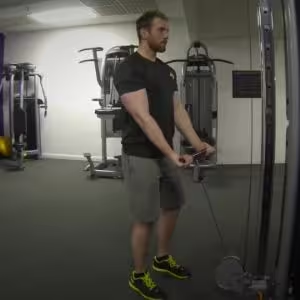
- Set Up: Attach a straight bar or EZ-curl bar to the low pulley of a cable station. Ensure the weight stack is securely set.
- Stance: Stand facing the machine with your feet shoulder-width apart for a stable base. Grasp the bar with an underhand (supinated) grip.
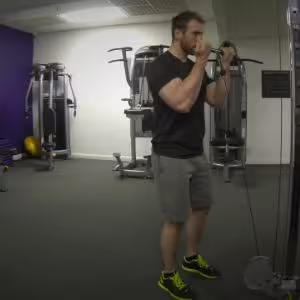
- Execution: Keeping your elbows pinned to your ribcage to avoid involvement of the anterior deltoids, curl the bar toward your upper chest by contracting your biceps.
- Contraction: Squeeze your biceps hard at the top of the movement for a second to maximize peak recruitment.
- Extension: Slowly lower the bar back to the starting position under control, ensuring a full stretch in the biceps before the next rep.
The Science of Hypertrophy: Why Cable Tension Works
Mechanical tension and metabolic stress are the two primary drivers of muscle growth. Unlike free weights, where the tension on the muscle varies throughout the lift (often dropping to zero at the top or bottom of a curl due to gravity), cable machines provide constant resistance.
This “time under tension” is a critical factor in hypertrophy. When you use a cable, the biceps are forced to work against resistance from the very beginning of the concentric phase all the way through the peak contraction and into the eccentric phase.
This constant tension leads to higher metabolic stress—the “burn” you feel when metabolites like lactate accumulate in the muscle cell. This swelling of the muscle cells signals the body to repair and grow larger fibers.
According to various health and fitness authorities like Healthline, balancing mechanical tension with metabolic stress is the most effective way to trigger muscle protein synthesis and long-term muscle adaptation.
Advanced Training Techniques for Huge Arms
When performing the Standing Biceps Cable Curl, to push past plateaus and maximize your arm development, consider incorporating these advanced techniques into your sets:
- Drop Sets: Perform a set of cable curls with a weight that allows you to hit failure around 10-12 reps. Immediately reduce the weight by 25-30% and continue for as many reps as possible without rest.
- Slow Negatives: Focus on the eccentric phase. By taking 3-5 seconds to lower the bar, you increase the mechanical load and cause more beneficial micro-trauma to the muscle fibers.
- Peak Contraction Holds: At the top of every rep, pause and squeeze your biceps for 2 seconds. This improves mind-muscle connection and increases muscle density.
For a full arm day routine, including triceps and forearms, you can explore our comprehensive Arm Workouts and programs to ensure you are training with optimal volume and frequency.
Standing Biceps Cable Curl Muscles Worked
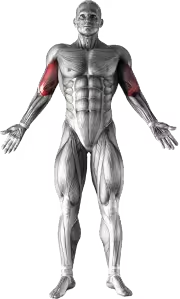
The Standing Biceps Cable Curl primarily targets the Biceps Brachii (both the long and short heads). It also engages:
- Brachialis: Located underneath the biceps, helping with arm thickness.
- Brachioradialis: A key forearm muscle involved in elbow flexion.
- Forearms: Essential for grip stability and overall arm aesthetics.
Effective Variations of the Standing Biceps Cable Curl
While the standard straight bar curl is fantastic, incorporating variations can help you target different parts of the arm:
- One-Arm Cable Curl: By performing the exercise one arm at a time, you can fix muscle imbalances and achieve a greater range of motion.
- Behind-the-Back Cable Curl: Step forward and face away from the machine. This puts the biceps in an extreme stretched position, which is exceptional for long-head development and building that peaked look.
- Cable Hammer Curls (Rope Attachment): Switch the bar for a rope and use a neutral grip. This shifts the focus to the brachialis and the brachioradialis, increasing overall arm thickness and forearm strength.
FAQ
Is the cable curl better than the barbell curl?
The Standing Biceps Cable Curl is superior as while barbell curls allow for heavier weight, cable curls provide more consistent tension, making them arguably better for isolation and hypertrophy.
Can I use different attachments?
Yes, using an EZ-bar attachment can be easier on the wrists, while a rope attachment can help emphasize the brachialis and outer bicep.
How many sets and reps should I do?
For hypertrophy, 3-4 sets of 10-15 reps with controlled tempo and 60-90 seconds of rest between sets is generally recommended.
Standing Biceps Cable Curl Images